What Are AI Tools in Education? Top Examples, Benefits, and How to Use Them
Published: 7 Feb 2026
Artificial intelligence is revolutionizing education, moving learning beyond textbooks and transforming classrooms. With over 60% of K–12 teachers already using AI tools, students now benefit from adaptive tutoring, instant feedback, and automated grading, creating personalized, efficient, and data-driven learning experiences.
AI tools in education are software powered by artificial intelligence technologies such as machine learning (ML), natural language processing (NLP), and educational data analytics. Also known as educational AI, AI-powered learning platforms, or smart classroom technology, these tools analyze student data, learning behavior, and performance patterns to enhance teaching, learning, assessment, and school management. Whether you’re a student, teacher, or institution, AI improves learning while showing what are AI tools in education and how they make education smarter.
In this article, we cover what AI tools in education are, how they work, and the different types used across modern learning environments. You’ll also see real-world examples, practical use cases for students, teachers, and institutions, along with the key benefits, challenges, and ethical concerns surrounding educational AI. By the end, you’ll understand how AI is used in education and be able to confidently choose the right tools for students, teachers, or institutions.
Now, let’s start by understanding exactly what AI tools in education are and how they work.
Key Takeaways
- Understanding what are AI tools in education is essential for modern, personalized learning.
- AI leverages machine learning (ML) to adapt content to each student’s pace and learning style.
- Natural language processing (NLP) powers automated tutoring, instant feedback, and writing assistance.
- Educational data analytics enables teachers to track progress, identify gaps, and make data-driven decisions.
- AI reduces administrative tasks, allowing teachers to focus on mentoring and interactive teaching.
- Institutions gain from optimized operations, predictive analytics, and improved student success outcomes.
- Used responsibly, AI tools in education enhance engagement, equity, and prepare students for
future-ready learning.
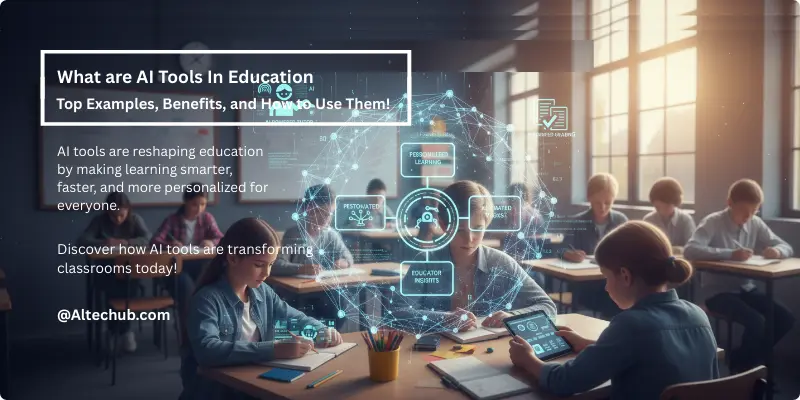
What Are AI Tools in Education?
AI tools in education are software applications and platforms that use artificial intelligence technologies, including machine learning (ML), natural language processing (NLP), and educational data analytics, to enhance teaching, learning, assessment, and school management.
Also called educational AI, AI-powered learning platforms, or smart classroom technology, these tools analyze student data, learning behavior, and performance patterns to:
- Deliver personalized learning experiences
- Automate repetitive tasks
- Provide actionable insights for educators
From AI-powered tutors that adapt to each student’s pace to automated grading systems that save teachers hours, AI tools in education are transforming classrooms worldwide, supporting teachers while helping students learn more effectively.
How Do AI Tools Work in Education?
AI tools in education operate through a continuous cycle of data collection, analysis, and adaptation. They gather structured and unstructured educational data, from quiz scores and assignment submissions to time-on-task metrics and forum interactions, and process it using machine learning algorithms that detect patterns, predict outcomes, and generate personalized responses.
For example, an AI math tutor tracks every problem attempted, time spent, errors made, and concepts mastered. This data powers the AI’s real-time decision-making, allowing it to adjust instruction instantly to meet the student’s needs. The core capabilities enabled by this process include:
- Identifying individual learning patterns and knowledge gaps
- Adapting content difficulty to match each student’s progress
- Providing instant, personalized feedback and actionable recommendations
- Generating predictive insights to support academic success
For educators, AI-driven analytics transform this data into actionable dashboards, making it easier to monitor class-wide performance trends, optimize lesson plans, and make timely, data-informed decisions, all while saving hours on routine administrative tasks.
Types of AI Tools Used in Education
AI tools in education come in diverse forms, designed to enhance learning, teaching, assessment, and institutional management. Leveraging machine learning (ML), natural language processing (NLP), adaptive learning algorithms, andeducational data analytics, these tools improve personalization, efficiency, and accessibility across the educational ecosystem.
1. AI Tutoring and Teaching Assistants
These digital mentors offer round-the-clock, individualized academic support. They simulate one-on-one tutoring by providing personalized explanations, practice questions, and instant feedback. They analyze student responses, learning patterns, and progress to tailor instruction in real time.
- ChatGPT: Used for guided study, brainstorming, and lesson guidance.
- Carnegie Learning: Provides adaptive math tutoring based on student performance.
2. Personalized and Adaptive Learning Platforms
These systems create a custom learning journey for every student. They dynamically adjust content, pace, and difficulty based on individual student performance and learning style. Using continuous learning analytics, they recommend targeted exercises and resources to fill knowledge gaps and enhance mastery.
- Knewton Alta: Delivers adaptive courseware with real-time personalization.
- Smart Sparrow: Enables creation of interactive, adaptive learning experiences.
3. AI Assessment and Grading Tools
Automation is revolutionizing how student work is evaluated. These AI tools automate the grading of assignments, quizzes, and exams while delivering detailed, consistent performance insights. They streamline evaluation workflows and help educators provide timely, data-driven feedback.
- Gradescope: Streamlines grading with AI-assisted rubric scoring and analytics.
- Turnitin: Ensures academic integrity through plagiarism detection and AI writing analysis.
4. AI Writing, Research, and Study Assistants
AI is becoming an indispensable partner for academic composition and analysis. Powered by text analysis and generation models, these AI tools help students and educators improve writing quality, organize research, and create study materials efficiently.
- Grammarly: Enhances grammar, tone, clarity, and overall writing quality.
- Notion AI: Summarizes notes, generates study guides, and organizes academic content.
5. AI Accessibility and Language Learning Tools
Inclusive education is powered by intelligent assistive technology. These tools enhance inclusivity through speech recognition, text-to-speech, translation, and adaptive interfaces. They support diverse learners, including those with disabilities or language barriers.
- Duolingo: Personalizes language learning paths using adaptive AI.
- Microsoft Immersive Reader: Provides text decoding, translation, and focus tools for accessible learning.
6. AI Administrative and Institutional Management Systems
Data-driven decision-making is the backbone of educational institutions. These systems optimize school operations, including scheduling, resource allocation, budgeting, and student retention tracking. Predictive analytics help identify at-risk students early, enabling timely interventions.
- Fetchy: Streamlines administrative workflows and teacher task automation.
- Ellucian Analytics: Uses predictive modeling to improve student success and institutional planning.
7. AI Lesson and Content Creation Tools
Teachers are reclaiming time with AI-powered content generation. These tools help teachers generate lesson plans, slide decks, handouts, discussion prompts, and multimedia learning materials, saving hours of prep time while maintaining alignment to standards.
- MagicSchool.ai: Offers 60+ AI tools for lesson planning, rubric creation, and communication.
- Curipod: Generates interactive, full lesson slide decks with polls and activities in seconds.
8. AI Classroom Engagement and Collaboration Platforms
Active participation is being redefined through smart interaction. These platforms foster interaction through AI-driven polls, discussions, group activities, and real-time feedback. They keep students engaged in both physical and virtual classrooms.
- Padlet with AI features: Enhances collaborative boards with smart suggestions and organization.
- Parlay Genie: Facilitates deeper student-led discussions with AI-generated prompts and feedback.
9. AI Plagiarism and Integrity Checkers
Maintaining academic honesty in the age of AI is a top priority. These tools uphold academic honesty by detecting unoriginal content, AI-generated writing, and improper citation. They help educators ensure authentic student work.
- GPTZero: Specializes in detecting AI-generated text in student submissions.
- Copyleaks: Provides comprehensive AI content detection and plagiarism checking.
10. AI Career and Skill Development Platforms
Future-ready skills are being mapped with personalized AI guidance. These platforms guide students in exploring career paths, building job-relevant skills, and accessing personalized learning pathways for professional readiness.
- LinkedIn Learning AI: Recommends courses tailored to career goals and skill gaps.
- Coursera with AI: Suggests personalized course pathways and skill development tracks.
These ten categories of AI tools form a connected ecosystem that empowers students, supports teachers, and streamlines institutional operations. By integrating intelligent tutoring, adaptive learning, automated assessment, writing support, accessibility tech, and administrative automation, educational environments become more personalized, efficient, and equitable, transforming how we teach, learn, and manage education.
Examples of AI Tools in Education
From personalized tutoring to automated grading, AI tools are reshaping how educators teach and students learn. The following table highlights ten standout tools that are widely used in classrooms today, each selected for its proven impact and relevance across key educational needs.
| Tool | Category | Key Use Cases |
|---|---|---|
| ChatGPT | AI Tutoring & Teaching Assistants | On-demand explanations, brainstorming, and lesson planning support |
| Carnegie Learning | AI Tutoring & Teaching Assistants | Adaptive, one-on-one math tutoring based on student performance |
| Knewton Alta | Personalized & Adaptive Learning Platforms | Adaptive courseware with real-time personalization |
| Smart Sparrow | Personalized & Adaptive Learning Platforms | Building and deploying interactive, adaptive lessons |
| Gradescope | AI Assessment & Grading Tools | Automated grading with AI-assisted rubric scoring |
| Turnitin | AI Assessment & Grading Tools | Plagiarism detection and AI writing analysis |
| Grammarly | AI Writing, Research & Study Assistants | Grammar, tone, and clarity improvements for writing |
| Notion AI | AI Writing, Research & Study Assistants | Summarizing notes and generating organized study materials |
| Duolingo | AI Accessibility & Language Learning Tools | Personalized, adaptive language learning paths |
| Microsoft Immersive Reader | AI Accessibility & Language Learning Tools | Text decoding, translation, and focus tools for accessible learning |
These tools represent just a snapshot of how artificial intelligence is being applied across the educational spectrum, from supporting day-to-day instruction to enabling more personalized, efficient, and inclusive learning experiences for all.
How AI Tools Are Used in Education
AI tools in education are more than technological innovations; they transform how students learn, teachers teach, and institutions operate. By leveraging machine learning (ML), natural language processing (NLP), and educational data analytics, these tools deliver personalized learning, optimize workflows, and support data-driven decision-making across the academic ecosystem, empowering every stakeholder to achieve better outcomes while saving time and enhancing engagement.
1. AI Tools for Students
Students are at the center of AI-powered education. AI tools deliver tailored learning experiences, instant feedback, and academic support that help students master concepts efficiently and stay motivated throughout their studies.
For example, a student struggling with algebra can use an AI tutor like Carnegie Learning to receive step-by-step explanations and practice problems targeted to their specific misconceptions.
- Personalized learning experiences and adaptive content
- Instant feedback on assignments and assessments
- Academic support through tutoring, research, and writing assistance
Looking for practical AI tools to support daily studying and learning? Check out our guide on the top AI tools for students to improve writing, notes, and learning.
2. AI Tools for Teachers & Educators
AI tools enable educators to teach smarter, not harder. According to recent implementation data, teachers using AI for planning and grading can save several hours each week, reclaiming time for direct student interaction and mentorship. By automating routine tasks, analyzing student performance data, and providing actionable insights, teachers can focus more on mentoring and fostering critical thinking instead of administrative duties.
For instance, a teacher can use Gradescope to grade dozens of assignments in minutes while simultaneously receiving analytics on which concepts students struggle with most.
- Automates grading, lesson planning, and classroom management
- Provides actionable insights through educational analytics
- Enables teachers to focus more on mentoring rather than administrative tasks
3. AI Tools for Schools & Institutions
At the institutional level, AI streamlines operations, improves decision-making, and enhances student success. Schools and universities can use these tools to manage resources, monitor engagement, and ensure academic integrity more efficiently.
For example, a university admissions office might use predictive analytics to identify prospective students who are most likely to succeed, helping allocate support resources effectively.
- Streamlines administrative processes and resource management
- Improves student retention analysis and engagement tracking
- Ensures academic integrity and data-driven decision-making
AI tools are reshaping education for students, teachers, and institutions alike. Students benefit from personalized learning and instant support, teachers save time while gaining insights, and institutions streamline operations and make smarter decisions. Together, AI creates a more effective, inclusive, and future-ready educational environment.
Benefits of AI Tools in Education
AI tools are transforming education by combining machine learning (ML), natural language processing (NLP), and data analytics to empower students, teachers, and institutions. Research suggests that AI-driven personalized learning can boost student progress by an average of 3–5 months compared to traditional instruction. They deliver personalized learning, automate workflows, and provide data-driven insights that enhance efficiency, accessibility, and outcomes across K-12, higher education, and online platforms. Adopting AI tools offers several key advantages:
1. Personalized learning tailored to individual student needs
This allows education to move beyond a one-size-fits-all model. AI platforms such as ChatGPT, Carnegie Learning, and Knewton Alta analyze student performance, learning pace, and knowledge gaps to deliver adaptive content and individualized learning paths.
2. Improved accessibility for learners with disabilities or language barriers
AI acts as a powerful equalizer in the modern classroom. Tools like Otter.ai, Duolingo, and text-to-speech AI software ensure inclusive education for students with diverse learning styles or language challenges.
3. Reduced teacher workload through automation
Freeing educators from administrative burdens unlocks their true potential. Grading platforms like Gradescope and lesson-planning assistants help teachers save hours on repetitive tasks, allowing more time for mentoring and interactive teaching.
4. Faster, more accurate assessments
Timely and objective evaluation is crucial for effective learning. AI-driven grading and plagiarism detection tools such as Turnitin provide consistent, reliable evaluations and instant feedback.
5. Data-driven decision-making for administrators
Moving beyond intuition, schools can now rely on concrete evidence. Educational analytics systems like Ellucian Analytics support informed decisions on student retention, resource allocation, and curriculum optimization.
6. Enhanced student engagement and motivation
Sustaining attention and curiosity is key to deep learning. AI tools like Classcraft and Quizlet Learn use gamification, personalized challenges, and adaptive feedback to maintain student interest and build confidence, transforming learning from a chore into an engaging experience.
7. Scalable educational systems for larger classrooms and online learning
This ensures quality doesn’t diminish as class sizes increase. AI enables seamless personalization and engagement in digital classrooms, online courses, and hybrid learning environments.
Integrating AI tools creates a more personalized, efficient, and inclusive learning ecosystem. Students gain adaptive support and motivation, teachers reclaim time for mentoring, and administrators make better data-driven decisions. Together, these benefits drive higher engagement, improved performance, and a future-ready education system. Need faster slides and smarter visuals for assignments or lessons? Check out our guide to AI tools for presentations that help students create slides faster.
Challenges and Ethical Concerns of AI in Education
While AI tools offer significant benefits, their implementation requires careful attention to critical challenges. Many schools lack clear frameworks; only about 31% have established AI policies, creating implementation gaps and consistency issues. Responsible adoption hinges on addressing these key concerns to ensure technology supports, rather than hinders, equitable and effective education. The key challenges include:
- Data Privacy & Security: Protecting sensitive student information collected for personalization is paramount, requiring robust encryption and strict compliance with privacy laws.
- Algorithmic Bias & Fairness: AI systems can perpetuate biases present in their training data, risking unfair outcomes for students based on background or learning style.
- Over-Reliance on Automation: Excessive dependence on AI can diminish essential human mentorship, empathy, and professional judgment in the classroom.
- Lack of Transparency: “Black box” algorithms can make automated grading or recommendations inscrutable, eroding trust among students, parents, and educators.
- Equity of Access: A “digital divide” may emerge if advanced AI tools are only available to well-funded schools, worsening existing educational inequalities.
Successfully integrating AI requires strong ethical frameworks, continuous bias audits, transparency in AI decision-making, and a commitment to augmented intelligence, where AI assists educators without replacing the human connection at the heart of learning. Want to use AI for writing and research without losing originality or academic integrity? Explore our guide on the pros and cons of AI writing tools and how to use them without losing your voice.
How to Choose the Right AI Tool: A Quick Guide?
Selecting the right AI tool depends on your role, objectives, and educational context. Whether you’re a student seeking writing and study assistance, a teacher looking for grading automation and lesson planning support, or a school administrator ensuring compliance and efficient operations, aligning AI tools with specific needs maximizes learning outcomes, streamlines workflows, and ensures safe, effective adoption.
1. For Students: Focus on Writing & Study Aids
Students should prioritize AI tools that improve comprehension, writing quality, and study efficiency. Accessibility across devices and intuitive interfaces ensures seamless integration into daily learning routines. Start with free tiers or trial versions to explore features before committing.
- Prioritize tools that enhance understanding, writing, and study efficiency (e.g., ChatGPT for explanations, Grammarly for writing, Notion AI for organization).
- Check accessibility and ease of use across laptops, tablets, or smartphones.
- Test free versions before upgrading to paid plans.
2. For Teachers & Educators: Look for Grading & Planning Tools
Educators benefit from AI platforms that automate repetitive tasks, provide actionable insights, and support data-driven teaching decisions. Ensure tools align with your curriculum and educational standards while helping manage classrooms efficiently.
- Seek tools that reduce administrative workload, such as automated grading (Gradescope) and lesson plan generation (MagicSchool AI).
- Ensure tools provide analytics for monitoring student progress and informing instruction.
- Verify alignment with your syllabus, learning objectives, and educational standards.
3. For Schools & Institutions: Consider Integration & Privacy
Institutions should prioritize AI solutions that integrate securely with existing Learning Management Systems (LMS) and comply with privacy regulations like FERPA or GDPR. Scalable platforms enable smooth adoption across departments, classrooms, and digital learning programs.
- Evaluate compliance with data privacy laws, including FERPA and GDPR.
- Ensure seamless integration with existing LMS and administrative software.
- Select tools that support institution-wide adoption and scalable learning solutions.
Matching AI tools to specific goals, whether enhancing learning, saving time, or ensuring secure, school-wide implementation, helps students, teachers, and administrators achieve better outcomes. By selecting solutions aligned with each role, AI becomes a powerful ally in creating personalized, efficient, and inclusive educational experiences.
The Future of AI Tools in Education
The future of AI in education promises smarter, more adaptive learning environments that anticipate student needs and enhance teaching effectiveness. By combining machine learning (ML), natural language processing (NLP), and predictive analytics, AI tools will increasingly support personalized learning, optimize instruction, and expand access to high-quality education worldwide. Looking ahead, we can expect more immersive AI tools using gamification and virtual reality to boost engagement, alongside tighter integration with Learning Management Systems (LMS) for seamless workflow. Human educators will continue to play a central role, with AI acting as a supportive partner rather than a replacement.
- Smarter, adaptive classrooms that tailor instruction to individual learning styles and progress.
- Intelligent tutoring systems that predict learning gaps and provide targeted interventions.
- Seamless integration of virtual, remote, and hybrid learning platforms for global accessibility.
- Enhanced teacher support through automation, analytics, and personalized insights, allowing educators to focus on mentoring and engagement.
AI tools are set to transform education into a highly personalized, inclusive, and efficient ecosystem. By augmenting human teaching rather than replacing it, AI empowers students, supports teachers, and enables institutions to deliver a future-ready learning experience on a global scale.
Conclusion
Understanding what are AI tools in education is key to transforming how students learn, teachers teach, and institutions operate. Powered by machine learning (ML), natural language processing (NLP), and educational data analytics, these tools deliver personalized learning, automate tasks, provide actionable insights, and support data-driven decisions. Used responsibly, AI tools enhance student engagement, help teachers teach smarter, and enable institutions to run more efficiently. Knowing what are AI tools in education and how to apply them effectively empowers students, educators, and schools to create a smarter, more inclusive, and future-ready learning environment.


- Be Respectful
- Stay Relevant
- Stay Positive
- True Feedback
- Encourage Discussion
- Avoid Spamming
- No Fake News
- Don't Copy-Paste
- No Personal Attacks
- Be Respectful
- Stay Relevant
- Stay Positive
- True Feedback
- Encourage Discussion
- Avoid Spamming
- No Fake News
- Don't Copy-Paste
- No Personal Attacks
