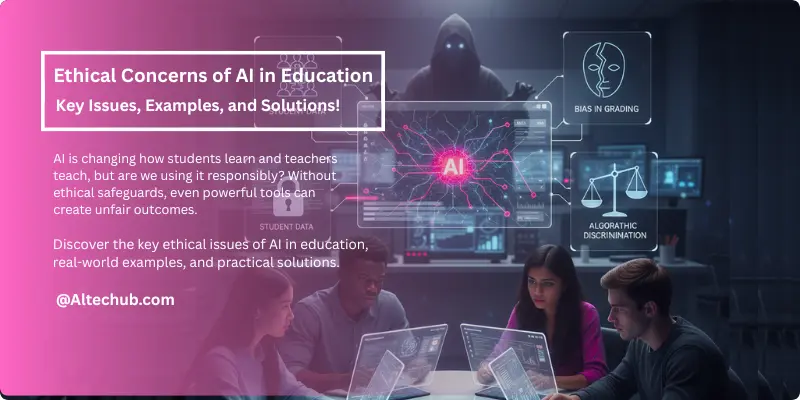
Ethical Concerns of AI in Education: Key Issues, Examples, and Solutions
Published: 27 Sep 2025
AI is transforming education, but are we considering the ethical cost? Beyond saving time and making classrooms more efficient, it also raises critical ethical questions about who benefits, who gets left behind, and how student data is used.
AI is revolutionizing learning by personalizing lessons, automating assessments, and giving teachers deeper insights into student performance. Its potential to improve outcomes is undeniable. Yet, these advances also surface the pressing ethical concerns of AI in education: data privacy, algorithmic bias, accountability, and the risk of overreliance. These issues pose fundamental questions about fairness and responsibility. If left unaddressed, they could undermine the very progress AI promises to deliver.
In this article, we’ll explore the key ethical challenges of AI in education, highlight real-world examples, and provide actionable strategies to balance innovation with responsibility.
Let’s get started!
Key Takeaways
- AI is transforming education, but it also presents critical ethical challenges.
- Student data privacy must be protected to avoid misuse or breaches.
- Algorithmic bias can create unfair advantages or exclude certain learners.
- Clear accountability is needed to define who is responsible for AI decisions.
- Overreliance on AI risks weakening human judgment and teaching values.
- Transparency in AI systems helps build trust among students and teachers.
- Balancing innovation with ethics ensures AI supports education responsibly.
- The future of AI in education depends on ethical frameworks that adapt to technology.
Understanding Ethical AI in Education
The growing role of AI in education is transforming the way we learn by personalizing lessons, automating routine tasks, and providing teachers with valuable insights into student progress. With these advantages, however, also come significant responsibilities. Ethical AI means using technology in ways that are fair, transparent, and respectful of students’ rights, ensuring it helps rather than harms.
Fundamental principles include:
- Avoiding bias that could disadvantage students based on race, gender, background, or disability.
- Ensuring transparency about how AI tools work and what data they use.
- Protecting sensitive student information from misuse or breaches.
- Defining clear accountability for AI-driven decisions and outcomes.
- Promoting equity so AI works well for all learners, regardless of background or ability.
Keeping these principles in mind helps schools and educators proactively address the ethical challenges that arise with the use of AI in education.
Why Ethical AI Matters in Education
As AI becomes more integrated into classrooms and learning tools, following ethical principles is essential. Ethical AI safeguards student privacy, ensures fairness, and strengthens trust among students, teachers, and parents. Without these measures, AI could reinforce bias or widen educational gaps instead of closing them. Clear standards help guarantee that AI supports learning responsibly. The key benefits include:
- Protecting sensitive student information from misuse or breaches.
- Promoting fairness and equity across diverse student populations.
- Building trust by clarifying how AI decisions influence learning outcomes.
- Supporting inclusive and personalized education without compromising ethics.
Understanding why ethical AI matters in education also means examining how AI is changing the education system. Recognizing these challenges shows why ethical principles are crucial, as they form the core ethical concerns surrounding AI and guide its responsible use. Beyond practical concerns, ethical AI upholds fundamental human rights frameworks, including the right to education without discrimination, the right to privacy, and the right to transparent and accountable systems, principles recognized by global standards like UNESCO’s Recommendation on the Ethics of Artificial Intelligence.
👉 Read about the uses of AI in education in our detailed article: Uses of AI in Education: Benefits, Challenges, and Future Trends.
Key Ethical Concerns of AI in Education
While ethical principles provide a foundation, the true challenge emerges in how AI is actually applied within classrooms. On one hand, AI offers the promise of personalized learning, streamlined tasks, and data-driven insights. On the other hand, it raises serious questions about fairness, privacy, transparency, and accountability that educators, students, and policymakers must confront. Striking the right balance between innovation and responsibility is essential, and with this in mind, let’s explore the most pressing ethical concerns and the drawbacks of AI in education.
1. Data Privacy and Student Surveillance
One of the most critical ethical issues in AI-based education involves how student data is collected, stored, and used. AI systems, including popular tools like ChatGPT, depend on vast amounts of personal and academic data to function, raising severe privacy risks that could have lasting impacts on students’ education and personal lives.
- Student data must be protected against misuse, profiling, or commercialization.
- Unauthorized access risks breaches and FERPA violations when records are shared.
U.S. laws like FERPA (student records) and COPPA (children’s data) require strict compliance, yet many platforms’ privacy policies still permit opaque data-sharing practices.
2. Algorithmic Bias and Discrimination
AI algorithms often reflect the biases present in their training data, which can unintentionally reinforce inequality in classrooms. Without proper oversight, this bias can influence grades, admissions, or learning opportunities.
- Automated grading may favor specific writing styles, disadvantaging others.
- Admissions algorithms may unfairly exclude students from marginalized groups.
3. Overreliance on AI Tools
While AI boosts efficiency, too much dependence can weaken the human aspects of education, like empathy and creativity. Overreliance risks reducing the teacher’s role to following machine-generated suggestions.
- Chatbots cannot replace the emotional support teachers provide.
- AI recommendations may overshadow teacher judgment in key decisions.
- This contradicts constructivist learning theory, which values active struggle for deep learning.
- It risks creating passive learners lacking critical thinking for future careers.
4. Student Data as “Free Labor” for AI Training
When students use AI tools like ChatGPT for assignments, their prompts and interactions become training data that improves the AI’s capabilities, effectively providing free labor to tech companies. This raises ethical questions about whether educational institutions should require students to contribute to corporate AI development without compensation or explicit consent.
- Student interactions with tools like ChatGPT become free training data for tech companies.
- Institutions face ethical questions about requiring uncompensated contributions to AI development.
5. Digital Divide and Inequality
Not all students have equal access to AI tools or reliable internet connections. This lack of access creates a two-tiered system where some benefit from advanced resources while others fall behind.
- Unequal access widens the educational achievement gap.
- Tools designed mainly for major languages may exclude diverse learners.
6. Informed Consent and Transparency
Many students and parents are unaware of how AI works or the extent of data it collects. Lack of clarity makes it hard to trust AI-driven decisions that affect grades or opportunities.
- Black-box systems limit understanding of how decisions are made.
- Families may not be given clear options to opt out of data collection.
7. Unexplainable Black Box Algorithms
Many AI systems operate as black boxes; their decision-making processes are opaque, even to their developers. In educational contexts, this means students and teachers cannot understand, question, or appeal AI-generated decisions that affect learning outcomes.
- Black-box systems prevent understanding of how decisions are reached.
Lack of transparency leaves no recourse to challenge unfair outcomes.
8. Accountability and Responsibility
When AI makes mistakes, deciding who should be held responsible is complex. Without clear accountability, errors can negatively affect students without a clear path for resolution.
- Responsibility may fall on teachers, developers, or administrators.
- Educators may struggle to challenge AI outcomes they don’t fully understand.
Adding to this complexity, AI-detection tools often produce false positives, incorrectly flagging original student work as AI-produced. This can lead to unjust accusations, causing psychological distress and damaging trust in the educational environment.
9. Psychological Effects on Students
Continuous monitoring and feedback by AI tools can influence students’ mental well-being. While intended to guide learning, it may also increase stress and discourage creativity.
- Constant observation can make students feel anxious or pressured.
- Frequent corrections may reduce curiosity and risk-taking in learning.
10. Impact on Teacher Roles and Development
The introduction of AI is reshaping traditional teaching roles. While it can ease administrative burdens, it also demands new skills and training for educators to adapt effectively.
- AI frees teachers for personalized instruction but requires trust in its outputs.
- Without ongoing training, teachers risk feeling displaced or undervalued.
These concerns show that ethical AI in education is not just about technology; it’s about fairness, trust, and responsibility. Addressing them will be essential to ensure AI supports learning rather than undermining it.
Examples of Ethical Concerns of AI in Education
AI is increasingly present in classrooms, offering tools that personalize learning, automate grading, and support teachers. Yet these benefits are accompanied by tangible ethical challenges that directly impact students, educators, and institutional trust. Examining real cases makes the risks and the need for careful oversight immediately clear. The following examples illustrate how ethical concerns manifest in actual educational settings:
1. Bias in Automated Grading
Tools like ChatGPT-powered grading systems have been found to favor essays written by students from particular linguistic or socioeconomic backgrounds, resulting in unfair score discrepancies and reinforcing existing inequalities.
2. Student Surveillance & Privacy Erosion
Schools using AI‑powered monitoring software to track students’ online activity, keystrokes, or even facial expressions during exams raise serious concerns about excessive surveillance and the violation of student privacy.
3. Over‑Reliance on AI‑Generated Feedback
When students depend exclusively on AI tutors like ChatGPT or similar chatbots, they may miss opportunities to develop critical thinking, creativity, and the ability to learn through productive struggle, skills that are central to holistic development.
These real‑world cases underscore why educators, administrators, and policymakers must critically evaluate AI tools before full‑scale adoption. Recognizing practical implications is the first step toward implementing AI in ways that protect fairness, privacy, and meaningful learning.
Ethical AI in Education: Your Quick-Start Action Plan
Understanding the ethical challenges of AI in education is crucial, but taking concrete action is what creates real change. This quick-start plan translates awareness into practical steps that teachers, administrators, parents, and students can implement immediately to foster responsible AI use:
| If you are a… | Your Key Concern | Your First Step This Week |
|---|---|---|
| Teacher / Instructor | Bias in automated grading; over-reliance on AI. | Audit one tool: Review feedback from an AI grading assistant. Check if it varies unfairly between student groups. |
| School Administrator | Data privacy; institutional accountability. | Review the privacy policy of your most-used AI platform. Ensure it complies with student data laws (like FERPA). |
| Parent or Guardian | Student surveillance; unfair advantage. | Ask your school: “What is your AI use policy, and what options exist regarding my child’s data?” |
| Student | Transparency; fairness in assessment. | Ask your teacher: “Can you help me understand how the AI tool influenced my grade or feedback?” |
Taking these first steps builds a foundation of awareness and accountability. While individual actions matter, lasting systemic change requires a structured approach. The following section provides a comprehensive framework to help schools and institutions build an ethically sound AI strategy.
How to Address the Ethical Concerns of AI in Education: The Way Forward
Successfully integrating AI into education requires a thoughtful and proactive approach that prioritizes responsibility, transparency, and inclusivity. Stakeholders, including institutions, educators, students, and developers, must work together to create an environment where AI benefits all learners without compromising ethics or fairness. To move from concern to action, here are five essential steps to guide this effort:
1. Develop Ethical Guidelines
Educational institutions should establish clear, actionable principles that govern the use of AI, ensuring that all applications align with core ethical standards.
2. Educator Training
Teachers need comprehensive training to understand how AI systems function, their limitations, and how best to supervise or complement AI tools within the classroom.
3. Student Awareness
It is crucial to educate students about their rights related to data privacy, how their information is used by AI, and how AI influences their learning experience.
4. Inclusive Design
AI developers must prioritize diversity by designing tools that can accommodate various cultures, languages, and individual learning needs, preventing exclusion or bias.
5. Regular Audits
Continuous evaluation and auditing of AI systems should be conducted to detect and address biases, errors, or unintended effects promptly.
6. Implement AI Literacy and Digital Citizenship Education
Comprehensive AI literacy and digital citizenship programs help students understand AI systems, recognize biases, and use technology responsibly while maintaining academic integrity.
By embracing these measures, the educational community can harness AI’s potential responsibly while safeguarding fairness, transparency, and student well-being.
The Future of Ethical AI in Education
AI technology in education is evolving fast, and so is the conversation around ethics. In the future, we can expect smarter AI systems that explain their decisions better, making them easier to trust. There will also be more global efforts to create common ethical guidelines to keep AI fair and transparent. Importantly, students and teachers will have a stronger voice in shaping how AI is used in schools. The challenge will be balancing innovation with preserving the human connection that’s key to effective education. Looking ahead, the key developments will likely include:
- Developing AI systems that respect privacy and fairness from the ground up.
- Creating transparent algorithms that educators can understand and oversee.
- Promoting inclusivity so AI benefits students of all backgrounds and abilities.
- Encouraging ongoing dialogue among stakeholders to adapt ethical guidelines as technology advances.
- Leveraging AI to reduce educational disparities between underprivileged and well-resourced schools.
- Empowering students by giving them control and understanding of AI’s role in their education.
By keeping ethics at the heart of AI’s future in education, we ensure these technologies help build better, more equitable learning environments for generations to come.
Final Thoughts
AI in education offers tremendous opportunities, but its promise depends on addressing the challenges it brings. Safeguarding privacy, ensuring fairness, and preserving the human side of learning are essential. Among the most pressing issues are the ethical concerns of AI in education, from data privacy to bias and accountability. By fostering collaboration among schools, developers, policymakers, and families, we can build an education system where AI enhances learning without sacrificing trust or equity. Keeping ethics at the core of innovation is the key to balancing progress with responsibility and ensuring AI empowers the next generation of learners.
FAQs
AI is not inherently bad, but it can be misused. Proper policies and ethical considerations ensure it enhances learning without harming students.
AI can support personalized learning and efficiency. Schools should adopt it with clear guidelines to address ethical concerns like privacy and fairness.
Key issues include bias in AI algorithms, student privacy risks, transparency in decision-making, and overreliance on automated tools.
Schools ban certain AI tools due to concerns about bias, cheating, data misuse, and a lack of transparency in how AI affects students’ learning and assessment.
Key legal concerns include compliance with student privacy laws (FERPA, COPPA), data security regulations, and liability for AI-driven decisions. Schools must ensure AI vendors meet these legal standards.
Use AI as a learning aid for brainstorming and explanation, not to plagiarize. Always verify AI information, cite its use when required, and protect your personal data.
AI detection tools (like Turnitin’s AI detector) identify text from systems like ChatGPT. However, they are not fully reliable and often produce false positives, flagging human work as AI-generated. This creates ethical dilemmas: accusing students based on imperfect detection can damage trust and cause harm. Institutions should use these tools cautiously and allow students to appeal decisions.




- Be Respectful
- Stay Relevant
- Stay Positive
- True Feedback
- Encourage Discussion
- Avoid Spamming
- No Fake News
- Don't Copy-Paste
- No Personal Attacks
- Be Respectful
- Stay Relevant
- Stay Positive
- True Feedback
- Encourage Discussion
- Avoid Spamming
- No Fake News
- Don't Copy-Paste
- No Personal Attacks
