Pros and Cons of AI Writing Tools: How to Use Them Without Losing Your Voice
Published: 2 Feb 2026
Imagine drafting a full article in minutes with AI instant research, quick drafts, and SEO-ready headlines. It sounds ideal. But the real question isn’t how fast AI writing tools work; it’s when they help and when they hurt. For marketers, they promise scalable content. For students, they raise academic integrity concerns. For writers, they challenge originality and creative depth.
Understanding the true pros and cons of AI writing tools means looking beyond the hype of speed and automation. Powered by advanced language models, these tools can generate blogs, marketing copy, and SEO text efficiently, yet they still struggle with emotional nuance, factual accuracy, and human judgment. Over-reliance can become a risky shortcut.
In this guide, we’ll break down the key benefits and dangers, from SEO impacts and cost savings to plagiarism risks and creative decline. Whether you’re a marketer, student, or professional writer, you’ll learn how to harness AI’s power without sacrificing quality, credibility, or your unique voice.
Let’s break down the pros and cons of AI writing tools in detail
Key Takeaways
- AI writing tools boost speed and efficiency, but lack human creativity, emotional depth, and judgment.
- Understanding their pros and cons is essential; they assist with drafting but require fact-checking and originality checks.
- Follow the 30% Rule: AI handles up to 30% of groundwork; you keep creative control and unique voice.
- Check industry rules (academia, marketing, journalism) before using AI to avoid misuse or penalties.
- Balance AI use with skill practice to avoid weakening your own writing abilities.
- For SEO, use AI for structure and keywords, but ensure content shows human experience to maintain rankings.
- Treat AI as a collaborative assistant, not a replacement, keeping human strategy and ethics at the core.

What Are AI Writing Tools?
AI writing tools are software powered by artificial intelligence, using natural language processing (NLP) and machine learning (ML) to understand, generate, and refine human-like text. They transform your input into content that sounds natural, contextually accurate, and ready for use in seconds. Unlike basic spell-checkers or templates, these tools can create entirely new content from scratch, adapt to your style, and even suggest strategic improvements.
These tools are widely used across industries to boost productivity, enhance creativity, and simplify writing tasks. They can brainstorm ideas, draft and edit articles, summarize documents, or even personalize messages for specific audiences. Whether you’re a marketer, student, blogger, or business owner, AI writing tools save time and effort while helping maintain content quality and consistency. Some popular AI writing tools include:
- ChatGPT: Conversational AI that generates text from prompts.
- Jasper: Focused on marketing copy, SEO content, and long-form writing.
- Copy.ai: Ideal for ad copy, social media posts, and idea generation.
- GrammarlyGO: Enhances grammar, tone, clarity, and readability in real time.
Overall, AI writing tools have become an integral part of modern content creation, offering a range of features to help writers, marketers, and professionals produce high-quality, engaging, and optimized content. To learn more about AI writing tools, check out our detailed guide on the Best Free AI Tools for Content Writing.
How Do AI Writing Tools Work?
AI writing tools function as intelligent assistants for content creation, helping users draft, edit, and optimize text efficiently. They don’t just generate words; they analyze your input, adapt to different writing styles, and offer suggestions to improve clarity, engagement, and readability. By automating repetitive tasks, these tools free writers to focus more on creativity, strategy, and storytelling. The key capabilities include:
- Analyze Language Patterns: Understand grammar, syntax, style, and context to produce polished text.
- Generate Content: Create coherent, relevant text based on your prompts for blogs, marketing copy, or SEO content.
- Adjust Tone and Style: Tailor writing for different audiences, platforms, or brand guidelines.
- Boost Productivity: Offer SEO suggestions, plagiarism checks, readability scoring, and multilingual support.
- Learn Over Time: Continuously improve accuracy, fluency, and naturalness through machine learning.
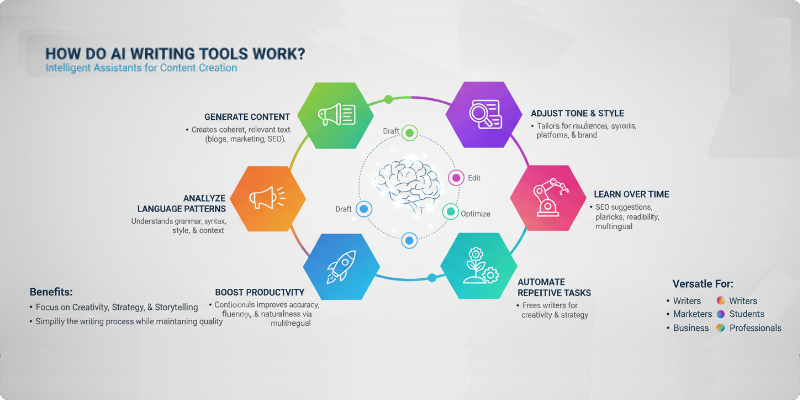
These capabilities make AI writing tools versatile for writers, marketers, students, and business professionals, simplifying the writing process while maintaining quality. Understanding how they work provides a strong foundation for exploring their benefits and limitations. To learn more, explore the best AI tools for students to simplify assignments, boost research, and study smarter.
Pros of AI Writing Tools
AI writing tools offer a range of benefits, making them invaluable for anyone creating content. They streamline writing tasks, reduce writer’s block, and speed up turnaround times. By automating drafting, editing, and formatting, users can focus more on creativity and strategy. Whether facing tight deadlines or managing multiple projects, AI tools help you work smarter, not harder. The key advantages of AI writing tools include:
1. Speed and Efficiency
AI tools can generate in-depth blog posts in seconds, ideal for tight deadlines or bulk content needs. They reduce the time spent on brainstorming, researching, and structuring content, allowing users to publish faster and more frequently. For businesses, this speed is crucial for staying relevant and maintaining a consistent online presence. This efficiency transforms content workflows, letting teams focus on creativity, strategy, and growth instead of repetitive tasks.
- Saves time on brainstorming and drafting
- Great for first drafts and outlines
- Enables scalable content production
These tools help users create content faster while keeping it high-quality and consistent. With AI handling the repetitive work, human writers can focus on nuance and originality.
2. Cost-Effectiveness
For businesses, startups, or freelancers with limited budgets, AI writing tools provide an affordable alternative to hiring professional writers or building large teams. They can handle multiple content tasks without ongoing costs, and many platforms offer free or low-cost plans, making high-quality content generation accessible. By cutting both time and labor costs, AI allows teams to maximize output without straining budgets.
- Many tools offer free or affordable plans
- Reduces dependency on large editorial teams
- Cost per word is significantly lower
This makes AI writing tools a practical choice for creating content efficiently while controlling expenses. Investing in AI can provide high ROI while still freeing resources for higher-value work.
3. Idea Generation and Writer’s Block Relief
One of the biggest challenges writers face is staring at a blank page. AI writing tools overcome this by providing instant suggestions for titles, outlines, intros, and more. Acting as a creative partner, they assist in brainstorming, sentence rewrites, and structuring content. This immediate support ensures ideas keep flowing even under tight deadlines or creative lulls.
- Generates topic ideas
- Offers sentence rewrites and paraphrasing
- Can expand or condense paragraphs on command
These features make AI tools a reliable aid for maintaining creativity and workflow momentum. They keep content development moving smoothly, preventing delays from writer’s block.
4. Multilingual Support
In a globalized world, reaching international audiences is critical. Many AI tools support multiple languages, allowing users to create or translate content quickly. This is particularly valuable for businesses involved in cross-border marketing, customer service, or global e-commerce. Multilingual capabilities help brands communicate consistently and efficiently across diverse markets.
- Supports multiple languages (depending on the tool)
- Improves global accessibility
- Useful for cross-border marketing
AI tools provide a practical solution for expanding reach and connecting with audiences worldwide. They enable seamless communication without relying solely on translators.
5. SEO Optimization Features
Many AI writing tools include built-in SEO capabilities to enhance search engine visibility. They suggest relevant keywords, analyze content structure, and help craft meta titles and descriptions. Some integrate with SEO plugins, streamlining optimization without switching tools. This integration allows content to be both reader-friendly and search-engine-ready with minimal extra effort.
- Keyword suggestions and density tracking
- Readability analysis
- Meta description and title generation
These features make AI tools a valuable aid for creating content that is engaging and search-friendly. They ensure content ranks better while maintaining readability and user engagement.
6. Customization and Tone Control
Modern AI tools can adjust style and tone based on your input. Whether content needs to be formal, casual, humorous, persuasive, or empathetic, AI adapts accordingly. This ensures brand consistency, helps target specific audiences, and allows content repurposing. Customizable tones allow writers to tailor messaging for multiple platforms and diverse audiences effortlessly.
- Adapts to brand guidelines
- Ideal for A/B testing content tone
- Useful for content repurposing
AI tools are a flexible solution for aligning content with your brand and audience needs. They make it easy to keep a consistent voice across campaigns and formats.
7. Consistency and Accuracy
AI tools maintain consistent tone, format, and structure, ideal for teams producing large volumes of content. They also catch common grammar, spelling, and punctuation errors, ensuring polished, professional writing. This consistency is crucial for maintaining a professional brand image and minimizing errors.
- Maintains consistent tone and structure
- Reduces grammatical and typographical errors
- Helps manage brand voice across multiple writers
This makes AI tools a reliable way to ensure quality and uniformity across content. Teams can trust the output while focusing on strategic and creative work.
8. Time-Saving Editing and Proofreading
Beyond content creation, AI excels in editing and proofreading. It can detect grammar issues, suggest clearer phrasing, and improve sentence structure within seconds. This automated process significantly reduces revision time, benefiting non-native speakers and anyone seeking better clarity and fluency. Writers gain more time to refine ideas, style, and storytelling instead of spending hours on minor corrections.
- Flags grammar, spelling, and style issues instantly
- Suggests improvements for clarity and tone
- Saves time during final content revisions
This makes editing faster, easier, and more accurate, so you can focus on refining ideas rather than hunting for errors. Ultimately, AI allows your content to reach professional standards with far less manual effort.
9. Data-Driven Insights and Analytics
Many AI writing tools offer analytics to track content performance, audience engagement, and SEO impact. These insights help writers and marketers make informed decisions, refine strategies, and optimize future content. By analyzing results in real-time, AI helps teams continuously improve content quality and relevance.
- Measures readability and engagement metrics
- Suggests improvements based on performance
- Supports data-driven content strategies
By leveraging analytics, AI tools not only create content but also guide smarter content planning. This ensures each piece contributes more effectively to your content goals.
10. Enhanced Collaboration
AI writing platforms often include sharing, commenting, and version-tracking features, making them perfect for teams. Multiple contributors can work on content simultaneously, and AI suggestions keep everyone aligned. Collaboration tools reduce miscommunication, streamline workflows, and keep content consistent across contributors.
- Facilitates team collaboration
- Tracks edits and version history
- Ensures uniform content quality across contributors
This makes AI tools a powerful solution for collaborative writing projects and team efficiency, enabling teams to produce cohesive, high-quality content faster and more reliably. Overall, AI writing tools streamline content creation, boost productivity, support creativity, and ensure consistency, making them essential assistants for writers, marketers, and teams alike.
Cons of AI Writing Tools
Despite their many benefits, AI writing tools come with notable limitations. While they can speed up writing and help overcome creative blocks, they cannot fully replace human judgment, intuition, or emotional depth. Common challenges include factual inaccuracies, ethical concerns, and the risk of over-reliance, which may impact skill development. Let’s explore the main disadvantages of AI writing tools in detail.
1. Lack of True Creativity
While AI excels at mimicking language patterns, it lacks genuine human creativity. Its content relies on existing data and statistical patterns rather than lived experiences, intuition, or emotional insight. Humor, irony, storytelling depth, and unique perspectives often fall flat, making content feel generic without human refinement. This limitation becomes obvious in content that demands originality, emotion, or storytelling depth.
- No lived experiences or emotions
- Struggles with humor, irony, and nuance
- Often sounds generic if not edited
Human input is essential to keep content engaging, original, and truly creative. Without human creativity, AI-generated content risks sounding repetitive and uninspired.
2. Factual Inaccuracies
AI can “hallucinate” facts, generating information that sounds plausible but is incorrect. This is especially risky in fields likescience, medicine, or law, where accuracy is critical. AI cannot verify information in real time, making careful human review necessary. This makes blind trust in AI-generated facts a serious risk.
- May produce outdated or false info
- Requires manual fact-checking
- Not reliable for specialized content
Always verify AI-generated content to maintain credibility and accuracy. Human fact-checking remains essential to prevent misinformation.
3. Risk of Plagiarism
Even when AI content seems original, it may unintentionally replicate phrases or ideas from existing sources. This creates potential intellectual property issues, particularly in professional publishing. Using plagiarism checkers is necessary to avoid ethical or legal complications. Originality is not guaranteed without proper review.
- Not fully original
- Possible legal or ethical issues
- Plagiarism checks are essential
Double-check originality to protect your work and reputation. Plagiarism risks make human review unavoidable.
4. Over-Reliance and Skill Degradation
Dependence on AI can weaken a writer’s own skills over time. For students, professionals, and aspiring authors, relying too heavily on AI may reduce critical thinking, editing skills, and personal growth. Long-term overuse can limit writing development.
- May decrease personal development
- Can lower critical thinking and creativity
- Not ideal for learners improving writing
Balance AI use with active skill practice to stay sharp. AI should assist learning, not replace it.
5. Limited Understanding of Context
AI often struggles with nuance, tone, or cultural context. It may interpret prompts literally or produce content that misses the intended meaning, especially with sarcasm, idioms, regional expressions, or trending topics. Contextual mistakes can reduce content relevance and clarity.
- Misinterprets prompts or questions
- Produces vague or off-topic content
- Requires frequent tweaking
Human oversight ensures content aligns with context, tone, and audience expectations. Context-aware editing remains a human responsibility.
6. Ethical Concerns
AI-generated content raises ethical questions: Should readers know content is AI-written? How does this affect jobs for writers and editors? What safeguards prevent misuse for misinformation? Responsible use is crucial. Ethics play a growing role in AI adoption.
- Potential job displacement
- Risk of AI spreading misinformation
- Transparency is necessary
Ethical considerations are essential for responsible AI adoption. Transparency and accountability protect long-term trust.
7. Limited Emotional Depth
AI struggles to convey genuine emotion or empathy, making it less effective for content that relies on human connection, storytelling, or persuasive messaging. Marketing campaigns, personal narratives, and heartfelt articles may lack authenticity. Emotional gaps reduce reader engagement.
- Cannot truly convey emotion or empathy
- Stories may feel flat or mechanical
- Reduces audience connection if overused
Emotional nuance requires human refinement for authentic engagement. Human emotion remains irreplaceable in meaningful writing.
8. Dependence on Data Quality
AI performance heavily depends on the quality of its training data. Poor data can lead to biased, inaccurate, or low-quality content. Users must remain vigilant and critically assess AI outputs. Input quality directly affects output reliability.
- Can inherit bias or outdated info
- Produces inconsistent quality without review
- Requires careful input and monitoring
Always monitor AI outputs and provide quality input to maintain reliability. Critical evaluation ensures consistent content standards.
9. Google SEO Penalty Risk
Although AI writing tools can generate SEO-friendly content quickly, over-reliance on AI may trigger penalties from Google’s “Helpful Content Update.” Sites that publish obvious AI-generated content without sufficient human editing risk lower rankings, even if keywords are optimized. Search engines increasingly prioritize human-first content.
- Can trigger Google’s spam filters
- May hurt long-term SEO performance
- Requires human review to maintain visibility
Balance AI efficiency with human editing to protect search rankings and ensure content quality, while remembering that AI cannot fully replace human creativity, judgment, or ethical responsibility. Thoughtful use, with careful review and oversight, lets you harness AI’s benefits without compromising originality, credibility, or overall content quality.
AI vs Human Writing: When to Use Each
Now that you know the pros and cons of AI writing tools, the next step is understanding how to use them wisely. AI can save time and streamline your workflow, but it cannot fully replace human creativity, judgment, and personal touch. Knowing when to rely on AI and when to trust your own skills is key to producing high-quality content that resonates with readers. This distinction becomes especially important as AI-generated content becomes more common across industries.
✅ Use AI Writing Tools WHEN
AI writing tools shine in tasks that require speed, volume, or repetitive effort. They are perfect for handling work that would otherwise take hours, freeing you up to focus on higher-level strategy and creativity. In these scenarios, efficiency matters more than originality or emotional depth.
1. You need speed and volume
- Writing 10+ product descriptions at once
- Brainstorming 50 different blog title ideas
- Creating first drafts quickly
- Translating content into multiple languages
2. For basic tasks
- Checking grammar and spelling
- Creating SEO meta tags and descriptions
- Getting content outlines and structure
AI excels when it handles the heavy lifting so you can focus on adding the human touch. This approach maintains high productivity without compromising overall content quality.
❌ AVOID AI Writing Tools WHEN
While AI can assist, it struggles with tasks that require originality, critical thinking, or deep expertise. In these situations, relying solely on AI can harm quality, credibility, and your personal brand. This is where human judgment becomes non-negotiable.
1. Creativity and personality matter
- Writing personal stories or memoirs
- Creating novels, scripts, or poetry
- Building your unique brand voice
2. Accuracy is critical
- Academic papers and school assignments
- Legal, medical, or financial content
- Important company announcements
3. You’re learning to write better
- When you’re trying to improve your skills
- Building your writing portfolio
- Developing your own style
In these cases, human input is essential to preserve authenticity, originality, and reliability. AI should support learning, not replace the thinking process behind it.
The Smart Middle Ground
Combining AI efficiency with human creativity is the ultimate approach. Instead of choosing one over the other, you can let AI assist while keeping your voice front and center. This balance ensures both speed and substance in your content workflow.
- Let AI start: Use it for the basic draft and structure
- You add the soul: Include your stories, expertise, and personality
- AI helps clean up: Use it for final grammar and SEO checks
- You make it shine: Apply the final polish to make it truly yours
This balance lets you enjoy the speed and efficiency of AI without sacrificing originality, quality, or authenticity. AI handles drafts, routine tasks, and structure, while human input ensures creativity, accuracy, and personal voice. By combining AI assistance with your expertise, stories, and final polish, you get efficiency without losing your unique touch. Used correctly, AI becomes a powerful writing assistant, not a creative shortcut.
Use Cases of AI Writing Tools (Following the 30% Rule)
AI writing tools help professionals across industries produce content faster for repetitive, time-sensitive, or creative tasks. They enhance productivity by assisting with drafting, editing, and brainstorming. Applying the 30% Rule, letting AI handle only a portion of the work, ensures you leverage its speed while keeping your content original, engaging, and aligned with industry standards.
1. Content Marketers
- What AI does: Article outlines, first drafts (20%)
- What YOU do: Brand stories, unique insights (70%)
- AI helps: SEO, grammar, formatting (10%)
- Rule: Always disclose AI assistance to clients to maintain transparency
2. Small Businesses
- What AI does: Product description templates (15%)
- What YOU do: Customer testimonials, unique selling points (75%)
- AI helps: Keywords, formatting (10%)
- Rule: Do not let AI replace personal customer interactions
3. Students
- What AI does: Research summaries, paper structure (10%)
- What YOU do: Critical analysis, arguments, originality (80%)
- AI helps: Grammar checks, citations (10%)
- Rule: Verify your institution’s policy on AI-generated content
4. Social Media Managers
- What AI does: Caption ideas, hashtags (25%)
- What YOU do: Brand personality, audience engagement (65%)
- AI helps: Scheduling, analytics (10%)
- Rule: Never rely on AI to respond to comments or DMs
5. Email Marketers
- What AI does: Subject lines, email templates (20%)
- What YOU do: Personalization, offers, value messaging (70%)
- AI helps: A/B testing, formatting (10%)
- Rule: Always test AI-generated subject lines before sending campaigns
These use cases illustrate how AI can efficiently handle repetitive or time-consuming tasks while you maintain control over creativity, strategy, and brand voice. By following the 30% Rule and adhering to industry-specific guidelines, you maximize productivity without compromising originality, engagement, or credibility.
Practical Tips for Using AI Writing Tools Responsibly
Building on the 30% Rule and industry guidelines, here are actionable tips for responsible AI use. Think of these as your guardrails: they let you accelerate productivity with AI while staying in full control of quality, originality, and ethical standards. These six strategies ensure you harness AI’s efficiency without falling into the common traps of over-reliance, factual errors, or ethical missteps.
1. Always Edit with Purpose
Don’t just tweak words, ask yourself: “Does this sound like me?” If not, rewrite it completely. Following the 30% Rule, AI should assist, not lead. Human oversight ensures your content maintains personality and authenticity.
2. Fact-Check Every Claim
AI can “hallucinate” facts or misstate information. Always verify statistics, dates, and expert quotes. For specialized fields like medical, legal, or technical content, consult real experts. Fact-checking safeguards credibility and prevents misinformation.
3. Know Your Industry’s Rules
- Students: Confirm AI policies with professors
- Marketers: Review client contracts for AI clauses
- Businesses: Set internal AI usage guidelines
- Freelancers: Be transparent with clients about AI support
Understanding industry-specific rules keeps AI use compliant and professional.
4. Keep Your Skills Sharp
Practice writing without AI regularly. Try “AI-free Fridays” or draft manually before using AI for editing. Balancing AI with hands-on practice preserves your growth and creativity.
5. Be Transparent When It Matters
- Product descriptions: Disclosure optional
- SEO content: Optional disclosure
- Academic work: Disclosure required
- Medical/legal content: Must disclose AI assistance
Transparency builds trust with readers, clients, and institutions.
6. Use the Right Tool for the Job
- Brainstorming: ChatGPT free version
- SEO content: SurferSEO or Frase
- Creative writing: Sudowrite
- Business writing: Jasper
- Grammar help: GrammarlyGO
Choosing the right AI tool maximizes efficiency while maintaining quality.
The key principles are human oversight, fact verification, and strategic transparency. Success with AI writing isn’t about shortcuts; it’s about creating a smarter workflow where technology enhances rather than replaces your expertise. Follow these tips, and you’ll harness AI’s power while protecting your credibility, creativity, and professional integrity. See our top AI tools for small businesses guide for practical examples.
Conclusion
Understanding the pros and cons of AI writing tools is crucial for any modern writer. These tools deliver undeniable speed, efficiency, and creative support, yet they come with clear drawbacks like a lack of originality, emotional depth, and the risk of factual inaccuracies. The key is balance: use AI as a powerful assistant, not a replacement, adhering to the 30% Rule and your industry’s ethical guidelines. By doing so, editing thoroughly, verifying facts, and maintaining transparency, you harness the pros of AI writing tools while actively mitigating their cons. This approach ensures you boost productivity without ever sacrificing the unique voice and authentic insight that only a human can provide.
Ready to see AI in action? Discover the top AI tools transforming classrooms in our guide, What Are AI Tools in Education, and see how they create personalized, efficient learning experiences.
FAQs
The main pros and cons of AI writing tools:
Pros: Speed and efficiency, cost-effectiveness, idea generation and writer’s block relief, multilingual support, built-in SEO optimization, tone customization, consistency, and time-saving editing.
Cons: Lack of true creativity, factual inaccuracies (“hallucinations”), plagiarism risks, over-reliance leading to skill degradation, limited emotional depth, ethical concerns, and potential Google ranking penalties.
Some popular AI writing tools include:
- ChatGPT (OpenAI): Best for general writing and brainstorming
- Jasper: Ideal for marketing teams and long-form content
- Writesonic: Strong for SEO and blog content
- Copy.ai: Excellent for ad copy and social media
- GrammarlyGO: Top choice for grammar and professional editing
- Rytr: Budget-friendly with multi-language support
- Sudowrite: Specifically designed for creative writing
Yes, ChatGPT offers a robust free tier, Rytr provides 5,000 characters monthly for free, and Copy.ai has a free plan for basic tasks. However, free versions often have usage limits and fewer features than paid plans.
No. AI tools excel at drafting, editing, and brainstorming but lack human creativity, emotional intelligence, and strategic thinking. They should be used as assistants, not replacements. Many industries (academia, journalism, publishing) strictly limit or require disclosure of AI use.
Yes, with caution. Tools like Frase and SurferSEO integrate AI with SEO optimization. However, Google’s “Helpful Content Update” may penalize obvious AI-generated content. Best practice: use AI for keyword research and outlines, but ensure final content has human expertise and originality.
- Increase productivity by automating product descriptions, email sequences, and social posts
- Maintain brand consistency across all content channels
- Scale content production without proportionally increasing staff
- Improve SEO performance with keyword-optimized drafts
- Reduce content costs by 40-60% compared to human-only workflows
Policies vary widely. Most universities allow AI for brainstorming and editing but prohibit its use for writing assignments. Tools like Turnitin’s AI detector are commonly used to identify AI-generated content. Always check your institution’s specific policy.
Yes. Google’s algorithms can identify patterns in AI-generated text. While not 100% accurate, websites with obvious AI content risk lower rankings under the “Helpful Content Update.” The safest approach is to significantly edit AI output and add original human insight.
- Academic publishing: Most journals prohibit AI-generated submissions
- Major news organizations: Reuters, AP restrict AI for core reporting
- Legal and medical fields: AI cannot provide professional advice
- Book publishing: Traditional publishers often require AI disclosure
Prices range from free (limited features) to $100+ monthly for team plans. Most individual plans cost $20-50/month. Enterprise solutions with custom branding and higher limits can exceed $500/month.


- Be Respectful
- Stay Relevant
- Stay Positive
- True Feedback
- Encourage Discussion
- Avoid Spamming
- No Fake News
- Don't Copy-Paste
- No Personal Attacks
- Be Respectful
- Stay Relevant
- Stay Positive
- True Feedback
- Encourage Discussion
- Avoid Spamming
- No Fake News
- Don't Copy-Paste
- No Personal Attacks
